
Search
Choosing custom dichroic glass panels requires more than selecting an attractive color from a catalogue. Buyers should evaluate the intended application, lighting environment, viewing angles, panel size and shape, safety configuration, fabrication requirements, and installation conditions before confirming a specification. Because dichroic glass changes its visible appearance with light and observation angle, a successful project depends on matching the optical effect to the actual architectural environment.
For commercial interiors, facades, partitions, feature walls, ceilings, retail displays, and art installations, early coordination between the designer, glass processor, and installer can help avoid color expectations or fabrication requirements that are difficult to achieve after production begins.
A supplier needs clear project information before recommending a suitable configuration. At minimum, buyers should define the application, dimensions, shape, desired visual effect, quantity, installation environment, and any secondary processing requirements.
Evergreen states that custom dichroic glass panels can be fabricated in different sizes, shapes, colors, and finishes for architectural, decorative, and artistic applications.
A practical purchasing brief can include:
| Specification Item | What Buyers Should Confirm | Why It Matters |
|---|---|---|
| Application | Facade, partition, wall, ceiling, display or installation | Determines safety, fabrication and visual requirements |
| Panel Dimensions | Required width, height and shape | Affects fabrication feasibility and installation |
| Desired Color Effect | Preferred reflected and transmitted appearance | Dichroic colors change under different lighting and angles |
| Lighting Conditions | Daylight, backlighting, spotlights or mixed lighting | Strongly influences the final visual effect |
| Viewing Direction | One-sided or multiple viewing angles | Determines how users experience the color shift |
| Glass Configuration | Monolithic or laminated construction where applicable | Influences safety and project suitability |
| Additional Processing | Edge work, holes, notches or other fabrication | Should be confirmed before production |
| Quantity | Prototype, small batch or project volume | Influences production planning and quotation |
| Installation Location | Interior or exterior | Affects specification and system requirements |
This type of information is more useful to a manufacturer than simply requesting “blue dichroic glass” or “rainbow glass.”
The most important point is that a dichroic glass color should not be evaluated as if it were ordinary tinted glass.
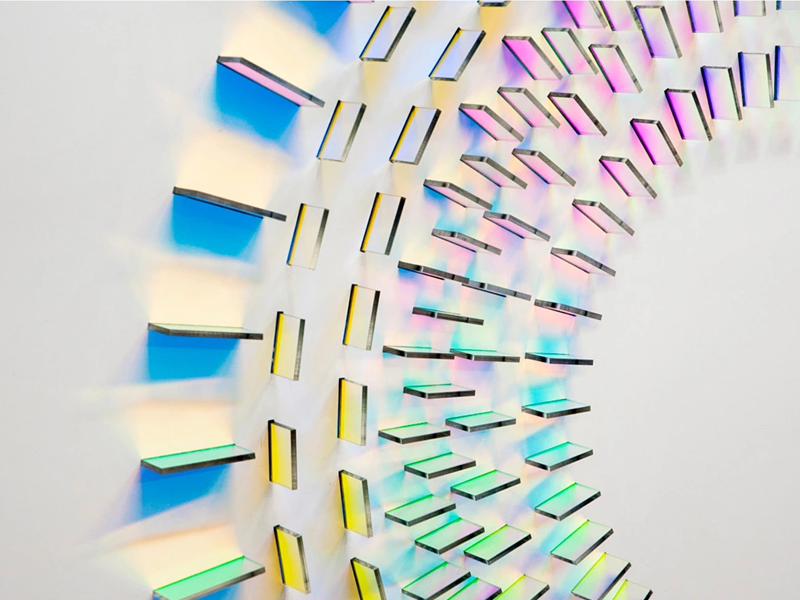
Dichroic coatings selectively reflect certain wavelengths while transmitting others. As lighting direction and viewing angle change, the apparent color can also change. A catalogue image therefore represents only one viewing and lighting condition.
Before approving a color, buyers should consider:
Whether the panel will receive direct daylight
Whether artificial lighting will be used
Whether the glass will be front-lit or backlit
Primary pedestrian viewing directions
Surrounding wall and floor colors
Whether users can see both sides of the glass
For high-visibility projects such as hotel lobbies, retail flagships, galleries, and corporate entrances, requesting a physical sample and evaluating it under representative lighting conditions is preferable to approving a finish from a screen image alone.
Yes. Size and geometry influence both fabrication feasibility and the way the color effect is perceived.
A large uninterrupted panel can produce a broad, continuous optical effect, while multiple smaller modules may create more repetition and changes as viewers move across the installation.
Irregular shapes can also be used as part of the design language, but buyers should confirm fabrication details before finalizing architectural drawings.
Evergreen's product information states that its custom dichroic glass can be produced in different sizes and shapes. However, the website does not publish a universal minimum or maximum size for this product, so project-specific dimensions should be confirmed directly rather than assumed.
The required safety configuration depends on where and how the glass will be installed.
For partitions, facades, overhead features, public areas, and other applications where post-breakage behavior is important, the project designer may need to evaluate a laminated construction according to the applicable project requirements.
Buyers investigating dichroic laminated glass should therefore confirm whether the chosen coating, substrate, interlayer, and fabrication sequence are compatible before placing an order.
Evergreen's laminated glass range is intended for architectural applications where properties such as safety, security, sound control, UV protection, and protection from broken glass may be required.
The important purchasing principle is not to assume that every dichroic panel can automatically be converted into every safety-glass configuration. The entire glass build-up should be reviewed at the specification stage.
They are central to the final appearance.
Dichroic glass works through reflection and transmission, so the same panel can create noticeably different visual impressions depending on where the observer is positioned.
For example:
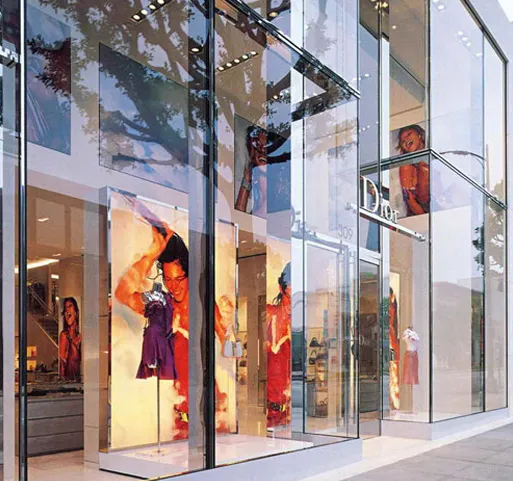
Retail storefront: Customers usually approach from changing angles, making strong color transitions desirable.
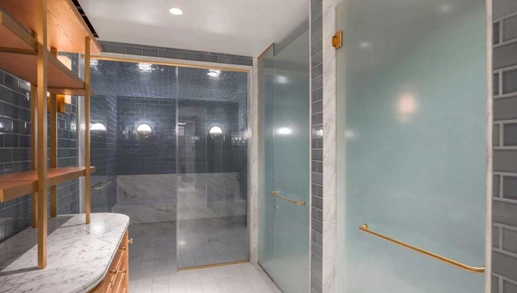
Office partition: Users may see both transmitted and reflected colors from opposite sides.
Feature wall: The designer may want controlled front lighting to emphasize reflected color.
Ceiling installation: Multiple viewing positions and artificial lighting can create a more complex visual field.
Facade: Daylight direction changes throughout the day, causing the appearance to evolve with time and observer position.
Buyers should therefore provide drawings, renderings, or photographs of the intended installation environment whenever the final visual effect is particularly important.
A reliable supplier should do more than quote a price. Buyers should assess whether the manufacturer can interpret design requirements and translate them into a manufacturable glass specification.
Important considerations include:
The supplier should clearly confirm which shapes, finishes, edge treatments, openings, and secondary processing options are feasible for the selected glass.
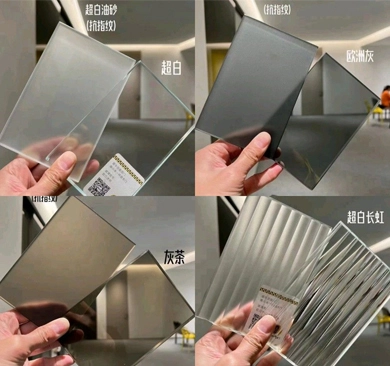
For color-critical projects, physical samples are useful for evaluating reflection, transmission, and appearance under actual project lighting.
Decorative glass often requires additional processing before installation. Evergreen describes its broader production capabilities as including CNC cutting, edge working, tempering, laminating, insulating, and printing processes.
If a requested combination cannot be produced reliably, an experienced supplier should identify the limitation before production rather than after fabrication.
Dichroic glass is most useful when dynamic color change is a core part of the design. However, buyers should not select it simply because a project requires decorative glass.
For privacy, matte surfaces, or diffused light, products from experienced etched glass manufacturers may be more suitable.
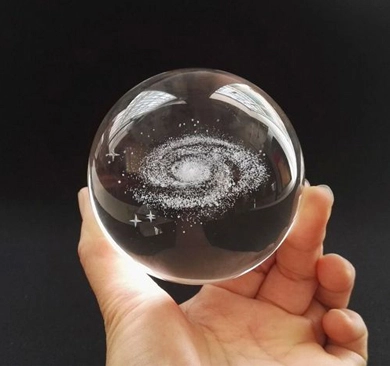
If a project requires highly controlled logos, graphics, text, or detailed patterns rather than color shifts, custom laser engraved glass can provide a different decorative solution.
Evergreen's Art Glass range includes dichroic glass, laser engraved glass, etching glass, carved art glass, and crystal glass, allowing designers to select different processes according to the desired visual result.
The selection can be simplified as follows:
| Design Requirement | Suitable Direction |
| Dynamic color changes | Dichroic glass |
| Changing reflection and transmission | Dichroic glass |
| Privacy or matte finish | Etched glass |
| Precise graphics or logos | Laser engraved glass |
| Deep texture or relief | Carved art glass |
Custom dichroic glass does not have one universal project price.
The final quotation can vary according to factors such as:
Panel dimensions
Shape complexity
Quantity
Selected coating or color effect
Required finishing
Secondary fabrication
Laminated or other project-specific configurations
Packaging and shipping requirements
Buyers comparing quotations should therefore confirm that suppliers are pricing the same specification. A lower quotation may not be directly comparable if it excludes fabrication steps, special packaging, or a required safety configuration.
For larger projects, providing complete drawings and quantities at the RFQ stage helps suppliers prepare a more meaningful quotation.
For color-sensitive architectural applications, this is strongly recommended.
A physical sample allows the designer and buyer to review:
Reflected color
Transmitted color
Appearance under daylight
Appearance under artificial lighting
Viewing-angle changes
Interaction with surrounding materials
A small sample cannot perfectly reproduce the experience of a full-size installation, but it provides significantly more useful information than relying only on digital images.
For complex projects, a mock-up using the intended lighting and adjacent materials can further reduce uncertainty before full production begins.
The intended visual environment is one of the most important factors. Lighting, viewing angles, surrounding materials, and panel orientation all affect how the glass appears after installation.
Yes. Evergreen states that its dichroic glass panels can be customized in different sizes and shapes for architectural, decorative, and artistic projects.
Yes. Interior partitions are a suitable application because users can experience reflected and transmitted color from different sides and viewing angles.
Changes in lighting direction, background color, viewing angle, and panel orientation can all alter the perceived color. Samples should therefore be evaluated under conditions that resemble the final installation.
Provide application, dimensions, shape, quantity, desired visual effect, lighting conditions, safety or lamination requirements, additional fabrication details, project destination, and any available drawings.
Choosing custom dichroic glass panels is primarily a process of matching optical appearance, fabrication capability, safety requirements, and installation conditions to the project's design intent. Buyers should evaluate color under realistic lighting, confirm panel dimensions and processing requirements early, and determine whether additional safety configurations are needed.
By providing complete drawings, viewing conditions, quantities, and fabrication requirements before quotation, buyers can reduce specification uncertainty and achieve a dichroic glass solution that performs consistently with the intended architectural or interior design.