
Search
Dichroic glass and stained glass can both introduce color into architectural spaces, but they create very different visual experiences. Dichroic glass uses optical coatings to reflect and transmit selected wavelengths of light, so its apparent color changes with lighting and viewing angle. Stained glass generally relies on permanently colored glass pieces or decorative coloration to create a more stable composition. For modern architectural projects, dichroic glass is usually the stronger choice when designers want dynamic color, transparency, contemporary detailing, and interaction with movement, while stained glass remains appropriate when the design calls for traditional imagery, fixed color compositions, or a handcrafted heritage character.
The right material therefore depends less on which one is “better” overall and more on how the glass is expected to behave within the building.
The fundamental difference is how color is produced and experienced.
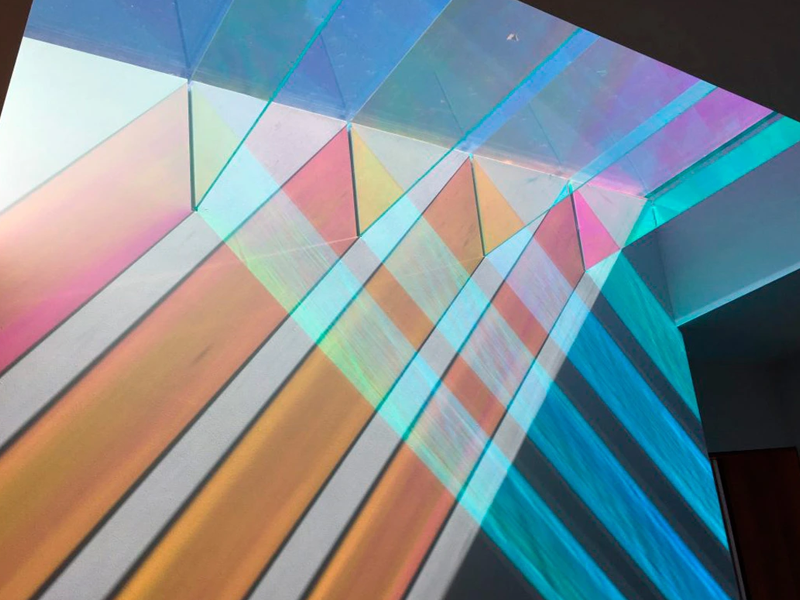
Dichroic glass uses multiple thin optical coating layers that selectively reflect some wavelengths while transmitting others. Evergreen describes this effect as being created through ultra-thin metallic oxide layers, with the visible color changing according to viewing angle and the direction and color of the light source.
Stained glass, by contrast, traditionally achieves its appearance through colored glass assembled into decorative compositions. The color itself is generally intended to remain visually recognizable rather than shift dramatically as the viewer moves.
This leads to two different design approaches:
| Design Factor | Dichroic Glass | Stained Glass |
|---|---|---|
| Color behavior | Changes with light and viewing angle | Generally more visually stable |
| Overall style | Contemporary, dynamic, optical | Traditional, artistic, illustrative |
| Transparency | Often transparent or translucent | Depends on glass composition |
| Viewer interaction | Strong; appearance changes as people move | Primarily composition-driven |
| Typical design focus | Light, reflection, movement | Pattern, imagery, storytelling |
| Common modern use | Facades, partitions, displays, feature walls | Decorative windows, heritage-inspired interiors |
Neither approach is universally superior. The appropriate choice depends on architectural intent.
Dichroic glass is particularly effective when the building itself is intended to change visually throughout the day.
Custom dichroic glass panels can be used in decorative facades, partitions, ceilings, retail displays, and glass wall installations. Evergreen also identifies hotels, galleries, offices, and luxury retail environments as suitable architectural and interior settings.
Its strongest advantage is that the surface is not visually static.
As sunlight shifts or people move around a panel, different reflected and transmitted colors become visible. This makes dichroic glass particularly suitable for:
Corporate headquarters
Hotel lobbies
Luxury retail stores
Art galleries
Cultural buildings
Exhibition spaces
Feature partitions
Contemporary facade elements
In these environments, movement itself becomes part of the design.
Stained glass remains a strong option when the project requires a fixed artistic composition rather than a changing optical effect.
For example, traditional stained glass is commonly associated with decorative windows, symbolic imagery, ornamental patterns, and spaces where the glass is intended to be viewed as an artwork.
It can therefore be more appropriate for:
Heritage-inspired architecture
Religious buildings
Restoration projects
Traditional hospitality interiors
Decorative windows with figurative artwork
Spaces requiring recognizable motifs or storytelling
The visual impact comes primarily from the composition and color arrangement rather than from changing reflection and transmission.
For architects, this distinction is important. If the client wants a permanent image or motif, stained glass may communicate that idea more clearly. If the goal is an evolving visual experience, dichroic glass is generally more suitable.
Both materials rely on light, but they react to it differently.
Dichroic glass is highly sensitive to lighting geometry. A panel may appear one color when sunlight reaches it from one direction and another as the angle changes.
Under artificial lighting, designers can deliberately position spotlights, backlighting, or concealed lighting to emphasize reflected or transmitted colors.
This gives lighting designers significant creative control.
Stained glass typically benefits from transmitted light passing through colored sections. Backlighting or daylight can increase saturation and make the decorative composition more visible.
The overall artwork remains comparatively stable, even though its brightness changes with illumination.
For commercial spaces where artificial lighting is part of the interior concept, dichroic glass often offers greater potential for creating interactive visual effects.
For contemporary partitions, dichroic glass often has an advantage because it can maintain transparency while adding color.
A transparent dichroic partition can separate spaces visually without becoming a fully opaque wall. People approaching from opposite directions may also see different combinations of reflected and transmitted colors.
Feature walls can use the same principle. Instead of showing one fixed decorative image, the wall changes as the observer walks past it.
Stained glass works differently. It is usually more appropriate when the partition or wall is intended to display a clear artistic motif.
Where a designer wants privacy or a softer translucent surface rather than either of these color effects, acid etched glass can provide another decorative direction. Evergreen's etching-glass range focuses on treated surfaces and decorative patterns rather than angle-dependent optical coatings.
Dichroic glass can be particularly effective on decorative facades because sunlight and pedestrian viewing angles naturally change throughout the day.
A facade can therefore appear different from the street, from inside the building, and at different times of day.
Evergreen states that laminated and tempered dichroic configurations can be considered for exterior applications such as facades, curtain walls, and decorative glazing systems, depending on substrate and coating specifications.
Stained glass can also be used architecturally, but its role is generally more focused on decorative windows and designed compositions than on creating an entire color-shifting envelope.
For large contemporary commercial projects, dichroic glass therefore usually provides greater compatibility with minimalist or high-tech architecture.
Customization goals should be defined before selecting the glass.
With dichroic glass, buyers typically need to determine:
Desired reflected colors
Desired transmitted colors
Primary viewing directions
Lighting conditions
Panel dimensions
Shapes
Interior or exterior application
Fabrication requirements
Tempering or lamination needs where applicable
Evergreen supports customized sizes, shapes, coating options, and fabrication requirements for dichroic projects.
Stained glass customization is more composition-oriented. Designers normally focus on the artwork, color palette, patterns, and arrangement of individual areas of glass.
If a project needs more physical depth and sculptural texture, carved art glass can provide another alternative. Evergreen's carved-glass process creates decorative effects through etching, carving, and engraving techniques that interact with light and shadow.
Neither dichroic glass nor traditional stained glass is always the most efficient option for detailed corporate graphics.
For precise logos, text, controlled imagery, or fine patterns, laser engraved glass may be more appropriate because laser processing can produce detailed marks, patterns, text, and imagery on glass surfaces.
This matters especially in:
Branded retail environments
Corporate offices
Hotels
Wayfinding systems
Exhibition displays
Recognition walls
In many projects, different decorative glass techniques can be combined rather than forcing one material to solve every design requirement.
Dichroic glass generally integrates more naturally into minimalist and contemporary spaces because its appearance comes from light rather than heavy graphical composition.
It can complement:
Metal
Concrete
Natural stone
Neutral wall finishes
Transparent glazing
Modern LED lighting
Open-plan interiors
Stained glass tends to become a more dominant visual artwork. That can be highly effective, but it often establishes a stronger stylistic direction for the entire space.
Designers should therefore ask whether the glass is intended to support the architecture or become the main artwork within the architecture.
A practical decision can be made by answering five questions.
If yes, dichroic glass is the stronger option.
If yes, stained glass may be more appropriate.
Dichroic glass is often useful where transparent or translucent separation is desired.
If yes, dichroic glass provides more opportunities to create changing effects through directional or back lighting.
Contemporary commercial architecture often suits dichroic glass, while stained glass can align more naturally with traditional or restoration-oriented environments.
For custom architectural projects, buyers should prepare enough information for the manufacturer to assess both the visual concept and fabrication feasibility.
The project brief should ideally include:
Drawings and dimensions
Intended application
Desired color effect
Viewing directions
Lighting environment
Quantity
Interior or exterior location
Safety requirements
Edge work and fabrication requirements
Packaging and delivery destination
Evergreen notes that dichroic pricing varies with purchase quantity and customization requirements, while shipping is affected by panel size, weight, processing requirements, and destination.
This means buyers should compare quotations using the same technical and fabrication scope rather than evaluating only the unit price.
No. Dichroic glass uses optical coatings to create angle- and light-dependent color effects, while stained glass generally relies on colored glass to create a more stable decorative composition.
Dichroic glass is often better suited to contemporary offices and hotels when designers want transparent partitions, dynamic color, feature walls, or strong interaction with lighting.
It can. Because selected wavelengths are reflected while others are transmitted, reflected and transmitted colors may appear different.
Stained glass is particularly effective when the design requires recognizable imagery, fixed patterns, or a traditional handcrafted appearance.
Yes. Evergreen states that appropriately configured laminated or tempered dichroic glass can be used for exterior decorative applications, subject to the selected substrate, coating, and project requirements.
Dichroic glass and stained glass serve different architectural goals. Stained glass is strongest when designers want fixed color compositions, recognizable imagery, and a traditional artistic character. Dichroic glass is more suitable when the design depends on changing light, movement, transparency, and a contemporary visual experience.
For decorative architectural projects, the best choice should be based on how occupants are expected to experience the glass, how lighting interacts with the installation, and whether the material needs to function as a static artwork or a dynamic part of the surrounding space.
This is the first one.