
Search
When people think of the Middle East, the first images that come to mind are often oil, deserts, and the deep-pocketed "oil tycoons." But if you believe that Saudi royals are content with nothing more than gold-plated marble and dazzling crystal chandeliers, you have completely missed the transformation currently reshaping this land.
Driven by Saudi Arabia's Vision 2030, an "arms race" in building energy efficiency has already begun. And at the heart of this competition, a seemingly unassuming yet highly sophisticated material—vacuum glass—is fast becoming the new "crown jewel" pursued by Saudi royalty and top-tier developers alike. It's not about whether they can afford it. It's about this: those who adopt it first are the ones who will truly stand atop the pinnacle of future architectural innovation.
During Middle Eastern summers, outdoor temperatures frequently soar to a blistering 50°C. Under such extreme climatic conditions, building cooling energy consumption reaches staggering levels. Traditional single-pane—or even standard insulating glass units—perform in this brutal sun like a "sheer veil," allowing outdoor heat to pour in while air-conditioning bills skyrocket.
As early as 2007, Dubai's iconic planned "Energy Tower" (Burj al-Taqa) had the foresight to plan for next-generation vacuum glass, aiming to reduce heat transfer by two-thirds and effectively turn the entire building into a giant "thermos." This was no pipe dream—it was a pragmatic response to harsh realities: in Saudi Arabia, a building's thermal performance directly dictates operating costs and occupant comfort.
The Saudi royal family's keen interest in vacuum glass is no mere display of wealth—it is grounded in deep strategic considerations.
1. National Will Under Vision 2030: Saudi Arabia is investing massively in megaprojects like NEOM. These projects are positioned as benchmarks for future cities, with strict requirements for LEED and other green building certifications—making high-performance energy-saving glass an absolute necessity.
2. Royals Personally "Endorsing" the Technology: Reports indicate that Saudi royal family members have personally traveled to China to inspect super-insulating glass technologies, explicitly expressing interest in forming joint ventures and promoting localized production. This goes far beyond mere acknowledgment—it elevates the technology to a national industrial strategy.
3. Academic Validation: In a 2025 research report, Professor Ali from the University of Sharjah specifically identified vacuum glass as a key breakthrough technology for building energy efficiency in hot climates, alongside phase-change materials (PCMs), recognizing it as "one of the optimal solutions" to high energy consumption. Such academic endorsement provides a solid theoretical foundation for widespread adoption.
Market forces are always the most sensitive. As soon as "Saudi royals" signaled strong demand for vacuum glass, Chinese companies were already taking the lead.
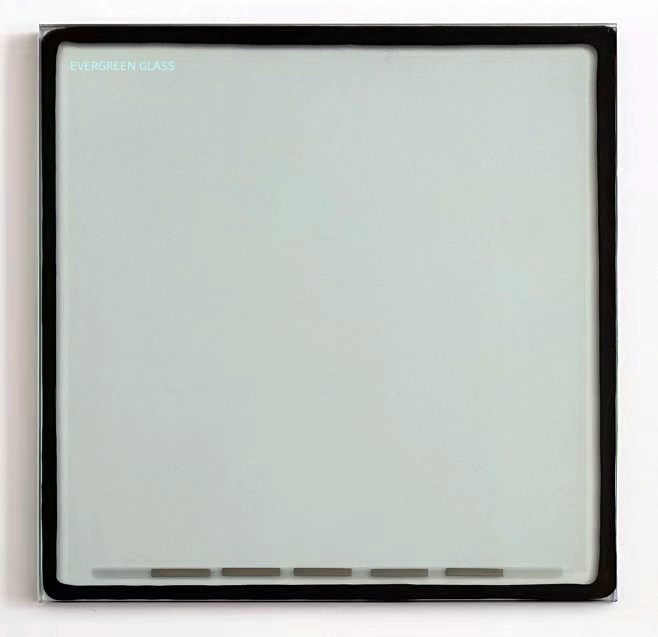
In June 2024, Jinan Evergreen Glass Co Ltd., a leading Chinese vacuum glass manufacturer, signed a strategic cooperation agreement with several Soudi Companies and Dragon City Trading Company. The agreement explicitly aims to jointly develop the Saudi and broader Middle Eastern markets, with plans to invest in local manufacturing facilities in the future.
This marks the rapid transformation of Chinese vacuum glass technology from a laboratory concept into tangible trade orders and localized production—landing in the Middle East at unprecedented speed.
Who says Saudi royals can't afford vacuum glass? The reality is that they are casting their votes—with real capital and their most prestigious national projects—for this game-changing energy-saving technology.
Under the scorching 50°C heat and within the grand narrative of Vision 2030, vacuum glass—with its ultra-low thermal transmittance (U-value) down to 0.4–0.8 W/(m²·K)—has become a "trump card" for the Middle East's most elite buildings. This isn't about price. It's about the next decades' energy bills, environmental responsibility, and the authority to lead at the forefront of building technology.
For glass suppliers worldwide, the "vacuum glass door" to the Middle Eastern market has already swung open. Seizing the opportunity hinges on one thing: delivering hardcore products that can withstand extreme climatic conditions while meeting stringent green standards. A true "Game of Thrones" in building energy efficiency is now playing out across the deserts of the Middle East.
This is the first one.